A Sesotho choral work asks a choir to do more than learn notes accurately. It asks singers to enter a language, a landscape and a history. For the conductor, pronunciation is not a decorative layer added during the final rehearsal: it shapes rhythm, phrasing, tone colour and the communication of meaning from the first reading.
This is especially important when preparing South African choral scores by composers such as Joshua Pulumo Mohapeloa. His music stands within a long tradition in which African composers, conductor-teachers and communities preserved repertoire through both singing and notation. The history of this practice is outlined in ACE’s account of the history of African music scores, where oral transmission, tonic solfa and staff notation are shown not as competing worlds, but as related forms of musical memory.
Begin with the language, not merely the score
Before assigning voice parts, read the Sesotho text aloud. Establish what the song is saying, where its images come from and who is speaking. A translation is an interpretative aid, not a substitute text to be fitted under the notes.
The ACE Pronunciation Guide to Sesotho Texts is deliberately described as a “rough guide”. That humility is valuable. Sesotho pronunciation and spelling may vary among speakers and regions, and singing introduces questions that do not arise in ordinary speech. Use the guide alongside a fluent or native Sesotho speaker whenever possible.
Several features are particularly useful for early rehearsal:
- Treat vowels as stable sounds rather than importing English diphthongs into every sustained note.
- Practise a, e, i, o and u slowly, listening for consistency between sections.
- Watch consonant groups such as hl, kh, th, ph, ts, tš and sh. They should be clear but never exaggerated into percussive effects.
- Remember that the written l can sound like d before i or u, as in examples such as lifela and lumela.
- Give neighbouring vowels their own shape. Do not automatically collapse every sequence into one English-style glide.
The objective is not to make singers sound artificially “foreign”. It is to remove the habits of their first language so that the Sesotho text can speak with greater clarity.
For more advanced preparation, mark difficult words in the score using IPA or a consistent phonetic guide. Research on “sung language” and choral pedagogy supports introducing language early, rather than postponing diction until the ensemble is already fixed in its musical habits.
Let the text determine the musical sentence
Text underlay is an interpretative decision. In polyphonic music, different voice parts may not present the whole sentence at the same time. A soprano may begin an idea while the bass completes it; an alto may sustain a vowel while the tenor introduces the next consonant. The conductor must therefore hear the text vertically as well as horizontally.
A useful score-study process is:
- Underline the principal words in each phrase.
- Mark the natural speech accents without forcing them into an English stress pattern.
- Circle long vowels that need to remain unified across the choir.
- Mark shared consonants that must be released together.
- Identify melismas, especially where one syllable extends over several notes.
- Translate the image or argument, then decide where the phrase gathers energy and where it releases.
Many Sesotho texts are rich in references to nature, community, faith and public life. Thaba-Bosiu, or “Night Mountain”, evokes the sandstone plateau in Lesotho that became the stronghold of Moshoeshoe I. The mountain rises dramatically from the plain, and its historical meaning should influence the conductor’s shaping: the music should not merely be loud, but should seem to gather mass and altitude.

The Thaba-Bosiu score is written for SATB choir and belongs to the Mohapeloa Critical Edition. Its historical setting gives conductors a starting point for discussing the difference between grandeur and heaviness. A broad phrase may need sustained breath and spacious vowels rather than constant forte singing.
A practical rehearsal sequence
A reliable sequence for Sesotho repertoire moves from speech to rhythm, from rhythm to pitch, and from pitch to expressive singing.
1. Speak the text naturally
Read the complete text in meaning groups. Avoid turning it immediately into a string of isolated syllables. Ask singers to hear the difference between a word that carries the image and a grammatical word that supports it.
2. Speak it in rhythm
Clap or tap the pulse lightly while the choir speaks the text. This reveals whether the underlay encourages natural pronunciation or places emphasis on an awkward syllable. It also helps singers coordinate consonants without the pressure of pitch.
3. Use a single pitch
Speak or chant the text on one comfortable note. This is an efficient way to connect diction with rhythm before harmony complicates the task. If the consonants become late, remove the pitch again and repair the spoken rhythm.
4. Rehearse each part with a piano reduction
ACE editions often include a piano reduction for rehearsal. Use it to establish entries, harmonic security and independence between SATB lines, but do not allow the keyboard to become the choir’s permanent support system. The piano should illuminate the architecture of the music; it should not conceal uncertain listening.
The Mohapeloa Critical Edition presents scores with original texts, English translations, editorial notes and rehearsal reductions. This is particularly valuable for conductors working beyond the repertoire’s original communities, because the translation helps singers understand the poem without pretending that English can replace Sesotho in performance.
5. Reunite the parts without the piano
Once each section is secure, remove the piano and ask the choir to retain the inner hearing developed during sectional work. Return to the keyboard only to diagnose a pitch or rhythmic problem. This keeps the final sound rooted in the voices.
Choral rehearsal research commonly recommends isolating one problem at a time before reintegrating it into the whole. The University of Florida’s advanced choral rehearsal techniques materials provide a useful broader framework for sequencing musical, vocal and expressive goals.
Repertoire as language in place
A conductor can build a thoughtful rehearsal programme by placing several works beside one another.
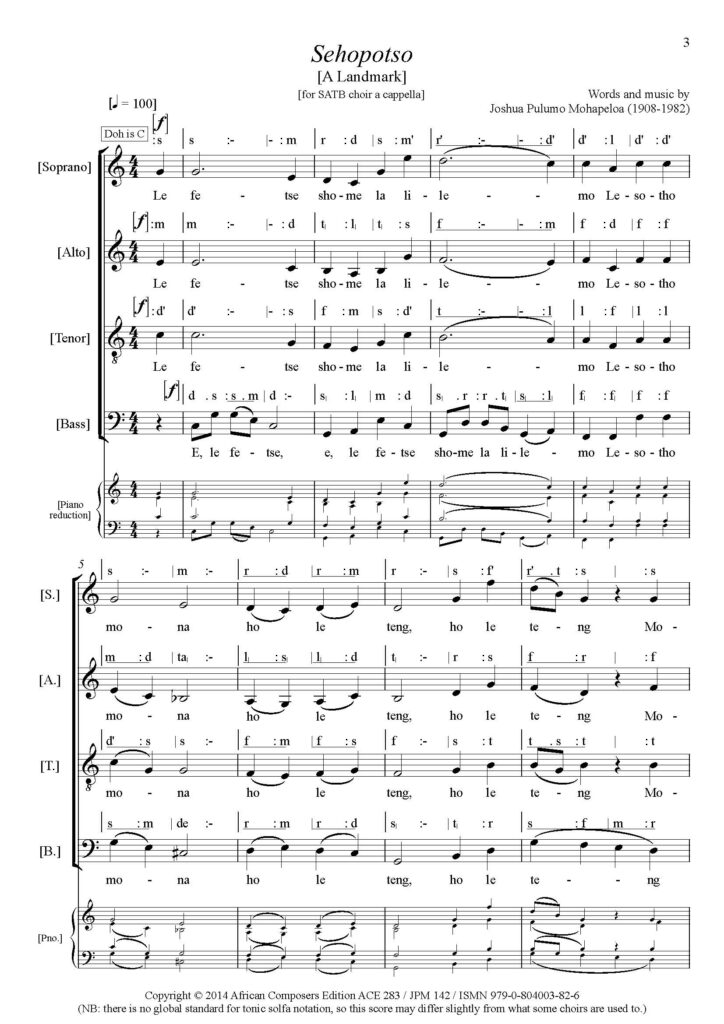
Sehopotso, meaning “A Landmark”, was written in 1978 to celebrate the tenth anniversary of the Lesotho Family Planning Organisation. Its public subject invites a clear, purposeful delivery, but the choir should avoid turning every phrase into a proclamation. The work belongs to a living civic world: its sound should have human warmth as well as ceremonial strength.
Eben-Ezer has a devotional and commemorative character. Its text recalls a monument associated with the founders of the Lesotho Evangelical Church. Encourage the choir to distinguish reverence from stiffness: consonants must remain intelligible, while sustained vowels carry the sense of thanksgiving.
Lipshamathe, translated as “Juicy Stories”, is more ironic. Its text concerns wealth, gossip and social inequality. The title’s apparent playfulness should not lead to a superficial performance. Ask singers to find the knowing smile beneath the words: the sound of a community observing human behaviour closely.

The Michael Mosoeu Moerane catalogue offers a second Sesotho-language tradition for conductors to explore. It is worth comparing composers without flattening their differences. Similar language does not mean identical musical identity, historical circumstance or vocal style.
The same principle applies beyond Sesotho. Ephraim Amu’s works in Twi, such as Yɛn ara asase ni, belong to a different linguistic and cultural setting. A choir should seek guidance for Twi pronunciation rather than guess from spelling or assume that a successful Sesotho method transfers unchanged.
Notation is a learning resource, not a substitute for listening
Many African choral scores are encountered through tonic solfa sheet music, staff notation or editions offering staff and solfa notation together. For the conductor, the central question is not which system is superior, but how the chosen score can support informed singing.
A dual edition can help a choir connect a familiar solfa tradition with staff notation. A staff-only score can open African sheet music to musicians trained elsewhere. In either case, the printed page remains a record of a musical culture that must be animated by voices, language and rehearsal.
It is also important not to confuse vocal editions with piano repertoire. Surendran Reddy’s Don’t Give a Damn Blues, also available through the Creativity Grades EDI (List C) page and the List D Creative Freedom page, is an example of complex rhythms represented in classical staff notation. It is explicitly not an example of solfa or dual notation, and it is not prescribed List D repertoire.
For conductors seeking an authentic choral scores download, the ACE performance resources and individual score pages provide a practical starting point. Use the score to prepare carefully, then let the choir’s ears, breath and understanding complete the work.
Keep reading
- Staff vs solfa: which is better for your African choral performance?
- How to read tonic solfa and staff notation side by side
- Are African choral scores dead? Do people still read staff notation in 2026?
- Looking for authentic African sheet music? Here are 10 things you should know
The most respectful performance is not one that disguises the choir’s origins or imitates a recording without question. It is one that studies the language carefully, understands the landscape behind the text and allows the music’s inherited wisdom to become audible in the present.