Choosing African choral scores is not simply a matter of finding a beautiful melody or a well-known composer. The right score must fit your choir’s voices, reading skills, rehearsal conditions, language knowledge and performance purpose.
A school choir preparing for a festival may need accessible tonic solfa sheet music and a rehearsal piano reduction. A university ensemble may prefer staff notation with editorial commentary and translations. A conductor researching south African choral scores may require a critical edition that preserves historical sources while making the music practical for present-day performance.
This guide offers a selection process rather than another argument about which notation system is “best”. Staff, solfa and dual notation each serve different purposes. The important question is: which edition will help your choir learn, understand and perform this particular work responsibly?
1. Begin with a choir profile
Before browsing a catalogue or searching for a choral scores download, write a short brief for your ensemble.
Identify the voicing
Check the exact scoring before you buy. A score marked SATB requires soprano, alto, tenor and bass. Other works may be written for SSATB, SAATB, SATTB or a reduced treble choir.
This distinction matters. A choir with only three balanced sections cannot simply treat an SSATB score as ordinary SATB music. Similarly, an additional alto or tenor part may create richness but also increase rehearsal demands.
The ACE catalogue allows you to identify scoring before selecting a work. Joshua Pulumo Mohapeloa’s catalogue, for example, includes a large number of SATB works as well as pieces for SSATB, SAATB and other combinations.
Define the performance context
Ask what the choir is preparing for:
- A church service or liturgical occasion
- A school or university concert
- A choral competition
- A commemorative ceremony
- A language or music-history lesson
- A recording or scholarly project
A sacred SATB song by Ephraim Amu may be ideal for worship, while a patriotic work such as Yɛn ara asase ni may suit a ceremonial programme. A composition associated with a particular landscape, historical event or community should not be selected merely because its title appears in a search result. Its context should inform the interpretation.
Assess reading ability
Be realistic about what your singers can read independently.
- Staff notation only is suitable when singers are comfortable with pitch on the five-line stave and the conductor needs precise rhythmic information.
- Tonic solfa only may be efficient for choirs trained through movable-do or fixed-do solfa traditions.
- Dual notation is especially useful when the choir includes both solfa readers and staff readers, or when the teaching aim is to develop both skills.
A dual score may also help a conductor teach intervals, key relationships and harmonic movement without abandoning the familiar solfa system.
2. Compare the notation formats as buying decisions
The following table can help you select an edition according to your immediate needs.
| Format | Choose it when… | Check before buying |
|---|---|---|
| Staff notation only | Your choir, accompanist and conductor read standard notation fluently | Is the rhythm clearly engraved? Are language texts aligned accurately? |
| Tonic solfa only | Your choir learns primarily through relative pitch and solfa syllables | Can the conductor establish the starting key and provide reliable rehearsal support? |
| Dual staff-solfa notation | Your choir has mixed abilities or you want to build staff-reading skills | Are the solfa syllables aligned clearly with the staff and vocal parts? |
The choice is not only technical. Historically, tonic solfa became important in southern African choral life because it could be taught and shared where instruments, trained accompanists and printed resources were limited. The ACE history of African music scores explains how mission schools, presses and choir competitions helped establish this publishing tradition.
For modern conductors, the practical advantage of dual notation is that it respects this history while opening the repertoire to international staff-notation readers.
3. Look beyond the notation: what kind of edition is it?
A digital score may be a simple transcription, a performing edition or a critical scholarly edition. These are not interchangeable.
A performing edition
A performing edition should be clean, legible and immediately useful in rehearsal. Look for:
- Clear vocal labels
- Bar numbers
- Dynamic and tempo indications
- Correct text underlay
- Sensible page turns
- A defined voicing
- Rehearsal markings
This is often the best choice for a choir preparing a performance under time pressure.
A critical edition
A critical edition goes further. It may compare manuscripts, printed sources and later copies, while explaining editorial decisions. It may include historical notes, translations, pronunciation guidance and commentary on the work’s place in a composer’s development.
ACE’s Mohapeloa Critical Edition is a useful model. The edition presents works in both staff notation and staff notation with tonic solfa, alongside original texts, English translations, contextual information and piano reductions for rehearsal. The piano reduction is intended to support learning, not to replace the choral texture in performance.
For conductors, this information can change the way a piece is rehearsed. A translated text may reveal whether a phrase describes a mountain, a season, a national event or an intimate emotional state. The music then becomes more than a sequence of notes: it becomes a dramatic and cultural statement.
A complete volume or catalogue
If you are building a school, university or research collection, consider a complete volume rather than isolated scores. ACE’s collections catalogue and all-scores page are useful starting points.
A complete collection helps you compare works across time. You may observe how a composer reimagines an earlier hymn style, develops a recurring harmonic language or moves between sacred, patriotic and secular subjects.
4. Match the score to the choir’s musical and cultural experience
For a choir beginning with dual notation: Mohapeloa
Joshua Pulumo Mohapeloa is an excellent entry point for choirs seeking authentic southern African repertoire in staff and solfa notation. ACE has published 145 extant works by the Lesotho composer, almost all choral, in dual staff-solfa and staff-only versions.
Consider:
- Sehopotso (A Landmark), an SATB work connected with a significant event in Lesotho’s national development.
- Eben-Ezer (Ebenezer), a sacred SATB work associated with the history of the Lesotho Evangelical Church.
- Thaba-Bosiu (Night Mountain), whose title refers to the dramatic sandstone plateau that served as the mountain fortress of Moshoeshoe I.

These works give conductors an opportunity to connect musical structure with place. Thaba-Bosiu is not an abstract title: it evokes steep rock, nightfall and the fertile historical memory of Lesotho. Before singing, ask the choir what kind of vocal atmosphere the image suggests. Should the opening feel monumental, spacious or urgent?
For Ghanaian SATB repertoire: Ephraim Amu
ACE’s Ephraim Amu collection includes SATB African songs from 1920–1933. These works are particularly useful for choirs looking for Ghanaian repertoire with Twi texts and clearly defined sacred, secular and patriotic categories.
Possible starting points include:
- Akwaabadwom : Welcome song
- Yɛn ara asase ni : This is our own land
- Momma yɛnkɔ Betlehem : Let us go to Bethlehem
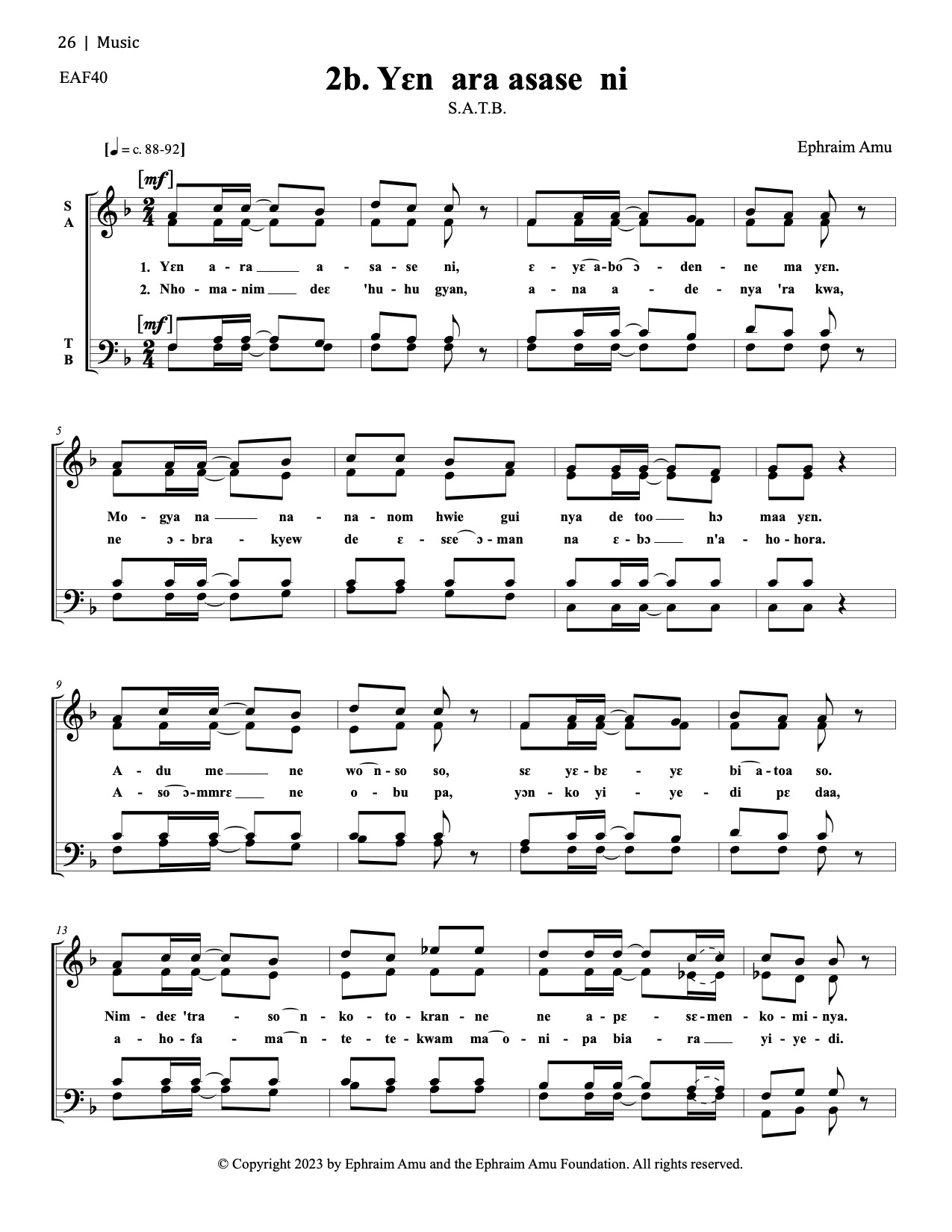
When selecting one of Amu’s songs, consider whether your choir can pronounce the text accurately and whether the programme gives the work an appropriate setting. The English translation is a guide to meaning, not a replacement text to be sung. Where possible, consult a language specialist or fluent speaker, and let the natural rhythm of the words shape the phrasing.
For advanced study: Moerane and Tamusuza
Conductors seeking a deeper survey of African art music should explore the Michael Mosoeu Moerane catalogue and its catalogue of works. Moerane’s music is valuable for choirs and researchers interested in how indigenous subjects, southern African history and formal concert traditions interact.
For East African contemporary music, consult ACE’s page on Justinian Tamusuza. His work draws on Ugandan and Bugandan musical experience while engaging with contemporary classical techniques. It may not always be a direct choral choice, but it can broaden a student’s understanding of how African musical ideas are transformed within modern composition.
5. Check the rehearsal aids before you purchase
A score that looks impressive on screen may still be difficult to use in a rehearsal room. Check whether it includes:
- A piano reduction for learning parts
- Audio examples or historic recordings
- English translations
- Pronunciation guidance
- Composer biography and historical notes
- Separate staff-only and dual-notation versions
- Clear page numbering and bar numbers
ACE’s pronunciation guide to Sesotho texts is particularly useful for choirs approaching Mohapeloa or Moerane. The performance resources can also help conductors think beyond the printed notes.
6. Use Reddy to test your rhythm-reading expectations
A useful contrast is Surendran Reddy’s Don’t Give a Damn Blues. This is an example of complex rhythms represented in classical staff notation, and it can help students see how detailed rhythmic ideas are communicated on the stave.
It is important to state clearly that Don’t Give a Damn Blues is not an example of solfa notation or dual notation. It is a piano/jazz-ensemble work in the Surendran Reddy Performing Edition, not a choral score. It is listed as Grade 7 List C EDI repertoire through The Maestro Online’s Creativity Grades EDI page. It may also inspire a student’s own creative response through the List D Creative Freedom page, but it is not prescribed List D repertoire.
For choir leaders, the lesson is simple: do not judge a score only by its visual density. Study its rhythms, vocal ranges and rehearsal requirements before assigning it.
A final selection checklist
Before buying African choral sheet music, confirm:
- The voicing matches your singers.
- The language and cultural context suit the programme.
- The notation format matches your choir’s reading ability.
- The score identifies its edition and source.
- Translations and pronunciation support are available.
- The vocal ranges are practical.
- Rhythmic and harmonic difficulty suits the rehearsal schedule.
- A piano reduction, recording or other learning aid is included where needed.
- The score is purchased from a legitimate publisher and used in accordance with its terms.
The best African choral score is therefore not necessarily the simplest, newest or most famous. It is the edition that allows your choir to encounter the music accurately, intelligently and with respect. Whether you are selecting a dual-notation Mohapeloa anthem, an SATB Twi song by Amu, a scholarly work by Moerane or a contemporary composition connected with Tamusuza, the score should serve as both a practical rehearsal document and a bridge to the history from which the music emerged.